
Seeing Spots or Shadows in Your Vision? Understanding E...
Seeing Spots or Shadows in Your Vision? Understanding Eye Floaters and How They Develop
...
August 18, 2026

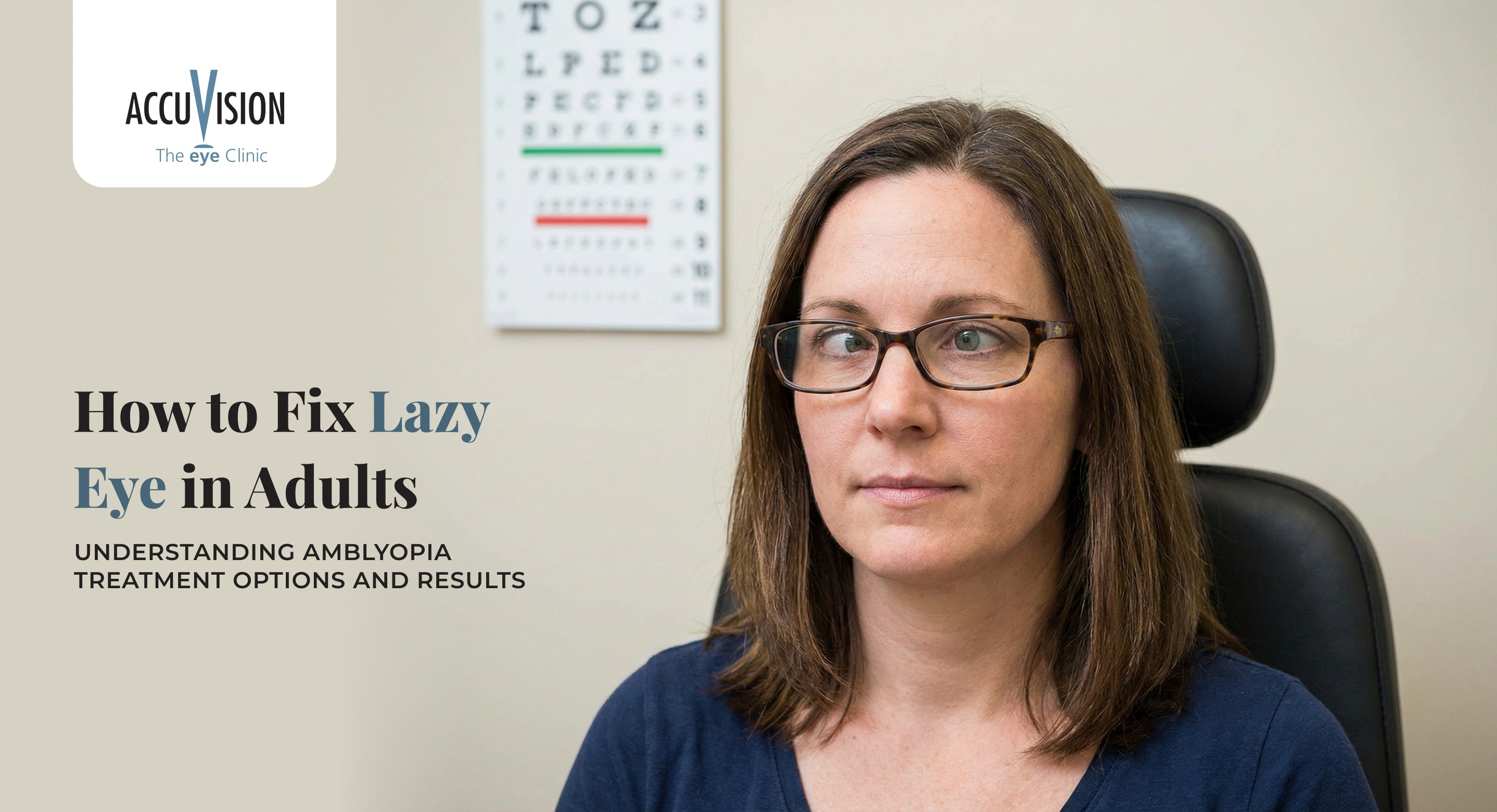
For many years, adults with a “lazy” eye were told that treatment was impossible. The condition, clinically known as amblyopia, was believed to be correctable only in early childhood
However, modern research has challenged this assumption. It now demonstrates that the adult brain retains greater adaptability than previously understood.
Improvement is indeed possible for adults with amblyopia, and treatment success depends on severity, underlying cause, and commitment to therapy.
With evidence-based approaches and realistic expectations, many adults can experience meaningful improvements in vision and quality of life.
This article is for informational and educational purposes only. It does not constitute medical advice, and it should not replace a professional eye examination or personalised treatment plan. Please consult a qualified eye care specialist at AccuVision for proper diagnosis and recommendations.
Amblyopia develops when one eye fails to achieve normal visual acuity or quality, even with corrective lenses. The brain learns to favour the stronger eye, gradually suppressing signals from the weaker one.
The amblyopic eye in adults typically results from conditions that began during childhood:
Lazy eye or amblyopia in adults differs from simple refractive error. While glasses can correct myopia, hyperopia, or astigmatism, they cannot fully address amblyopia.
The problem lies not in the eye itself but in how the brain processes visual information. Neural pathways responsible for interpreting signals from the amblyopic eye have weakened through years of disuse.
This is why comprehensive treatment requires more than optical correction. It necessitates retraining the visual system to use both eyes effectively.
The traditional view held that visual development occurred within a strict “critical period” during early childhood. After age seven or eight, the brain was believed to lose its ability to form new visual connections or learn and adapt.
This belief stemmed from mid-20th-century neuroscience research. Studies on animals suggested that visual pathways became fixed once the critical period closed.
Consequently, many adult patients were told and indeed continue to be told that treatment for lazy eye in adults was ineffective beyond childhood.
Recent studies funded by organizations, such as the National Eye Institute, have overturned this outlook. Research now confirms that the adult brain maintains neuroplasticity throughout life.
Neuroplasticity refers to the brain’s ability to reorganize itself by creating new neural connections. With appropriate stimulation and training, the adult visual system can develop improved function in the amblyopic eye.
However, realistic expectations remain essential. Adult treatment typically requires more time than childhood intervention. Progress may be gradual, and complete normalization is not always achievable.
Professional supervision ensures that treatment is appropriately tailored and expectations align with clinical possibilities.
Treating amblyopia in adulthood requires a multifaceted approach. Optimal outcomes typically result from combining several strategies.
Properly prescribed spectacles or contact lenses form the foundation of lazy eye treatment for adults. Lenses alone rarely resolve amblyopia; they ensure both eyes receive clear visual input.
Correcting refractive errors reduces workload on the visual system. This makes subsequent therapies more effective and helps prevent additional strain.
Vision therapy represents the cornerstone of modern amblyopia treatment. These programmes involve supervised exercises designed to strengthen the weaker eye and improve coordination.
A typical regimen includes:
Sessions typically occur once or twice weekly under professional supervision. Home-based exercises prescribed between appointments reinforce progress.
Commitment and consistency are critical for achieving the best outcomes.
Specialised software programmes offer innovative approaches to treatment. These applications use engaging visual tasks to stimulate neural plasticity.
Dichoptic training, where each eye views different stimuli simultaneously, has shown particular promise. This technique forces the brain to integrate information from the amblyopic eye.
Perceptual learning software involves repeated practice of visual discrimination tasks, gradually enhancing brain processing.
Clinical studies indicate that regular use of these programmers can improve visual acuity and contrast sensitivity in adults.
Eye patching may occasionally benefit adults when used judiciously. Temporarily covering the stronger eye compels the brain to utilize the weaker one.
Modern approaches include part-time patching during specific activities and atropine drops to temporarily blur vision in the stronger eye.
However, patching alone rarely produces lasting improvements. It is most effective when integrated with a comprehensive program.
The most successful treatment for lazy-eye adults typically combines multiple interventions. A comprehensive programme might include:
| Treatment Component | Purpose | Typical Duration |
|---|---|---|
| Corrective lenses | Optimise optical clarity | Ongoing |
| In-clinic vision therapy | Supervised skill development | 3–6 months |
| Home exercises | Reinforce progress | Daily, 15–30 minutes |
| Computer-based training | Enhance neural plasticity | Several months |
| Periodic evaluations | Monitor progress | Every 4–6 weeks |
Professional oversight ensures each component works synergistically. Regular assessments allow for adjustments based on individual response.
Understanding realistic outcomes helps patients approach treatment with appropriate expectations. The degree of improvement varies considerably between individuals.
Many adults undertaking comprehensive lazy eye treatment for adults experience:
Several variables affect treatment success:
Noticeable improvements typically emerge within three to six months of consistent treatment. However, continued refinement may occur over longer periods
Patience remains essential. The visual system requires time to establish new neural pathways. Professional monitoring ensures realistic expectations and provides encouragement throughout the journey. Progress is rarely linear, with periods of rapid improvement followed by plateaus being entirely normal.
If you suspect you have a lazy eye or were diagnosed with amblyopia as a child but never received treatment, a professional evaluation can determine whether intervention might benefit you.
Consider scheduling a comprehensive vision assessment if you experience:
Modern understanding of visual neuroplasticity means that age alone should not prevent you from exploring treatment options. With appropriate guidance and realistic expectations, many adults achieve meaningful improvements.
For decades, adults with amblyopia were told their condition was permanent and untreatable. Today, we know this isn’t true. The adult brain’s neuroplasticity means that improvement is possible at any age.
Treating a lazy eye in adulthood requires time and commitment, but the benefits extend beyond visual acuity. Enhanced depth perception, reduced eye strain, and increased confidence in daily activities can significantly improve quality of life.
Success depends on accurate diagnosis, evidence-based treatment, and consistent commitment to therapy. Professional guidance is essential for developing a personal treatment plan that addresses your specific needs.
At AccuVision, we specialise in comprehensive vision assessments and evidence-based treatments for adults with amblyopia. Our experienced team can evaluate your specific situation and recommend a personal approach tailored to your needs and goals.
This content was reviewed by the clinical team at AccuVision-The Eye Clinic, a trusted UK-based centre for comprehensive laser vision correction and specialised eye care. With expert Ophthalmologists and Optometrists across the UK, AccuVision ensures that every article reflects accurate, medically reviewed information and supports evidence-based eye health awareness. This content is for general educational purposes only and should not be construed as medical advice. Always consult a qualified eye care professional for personalised guidance and treatment for specific conditions.
Is lazy eye treatment effective later in life?
Yes, research confirms that adults can experience meaningful improvements. Many patients achieve better visual acuity, depth perception, and overall comfort.
Can adults improve vision without surgery?
Absolutely. Primary treatments for amblyopia in adults involve vision therapy, corrective lenses, sometimes surgical options and perceptual training
Do eye exercises help amblyopia?
When properly prescribed and supervised by an eye care professional, targeted visual exercises can significantly improve amblyopic eye function. Random online exercises are unlikely to be effective. Detailed examinations and tests to ensure no adverse side effects from any therapy are crucial for appropriate patient selection
Is treatment uncomfortable or disruptive?
Most treatments integrate well into normal routines. Vision therapy is usually performed in the home environment, with periodic in clinic visits to monitor progress.
How long does treatment take?
Treatment duration varies, but most programmes span three to six months or longer. Consistent engagement is sometimes more important than the specific timeframe.
Will vision return to completely normal?
Complete normalisation is not always possible, particularly in severe cases. However, even modest improvements can substantially enhance quality of life. Initial consultation helps give a realistic prognosis of potential for improvement.
References:
Daw, N.W., 2009. The foundations of development and deprivation in the visual cortex. [online] Available at: https://pmc.ncbi.nlm.nih.gov/articles/PMC2718236 [Accessed 24 Jan 2026].