Seeing Spots or Shadows in Your Vision? Understanding E...
Seeing Spots or Shadows in Your Vision? Understanding Eye Floaters and How They Develop
...
August 18, 2026
Millions of people worldwide have ditched their glasses and contact lenses thanks to laser eye correction. The results can be transformative. But most people don’t know that the procedure’s success depends as much on pre-operative screening and preparation as on what happens in the operating room.
The screening process helps decide who can and can’t have laser eye surgery to correct their vision. To keep your vision and eye health in excellent shape for a long time, you need to have this careful examination. This article talks about how the procedure works, who is a good candidate for it, and why the evaluation before the surgery is as important as the surgery itself.
Please note that the information in this blog is only for general educational purposes and should not be interpreted as professional medical advice. If you are considering laser vision correction, schedule a personalised eye examination at AccuVision to assess your eye health and suitability.
To learn how laser eye surgery corrects vision, it is essential to first understand how our eyes see and what happens when light focuses on the retina, or doesn’t.
The cornea, which is the clear surface in the front of the eye, and the lens within the eye play the primary role when it comes to projecting light onto the retina (the back of the eye where the photoreceptors are). Refractive errors can occur when the shape, length and focusing power of the eye are not optimal. Short-sightedness (myopia), long-sightedness (hyperopia), and astigmatism are all caused by irregularities in the shape, curvature and length of the eyeball – from the cornea, the lens and the retina. Eventually, this leads to blurred vision, necessitating correction through glasses or contact lenses
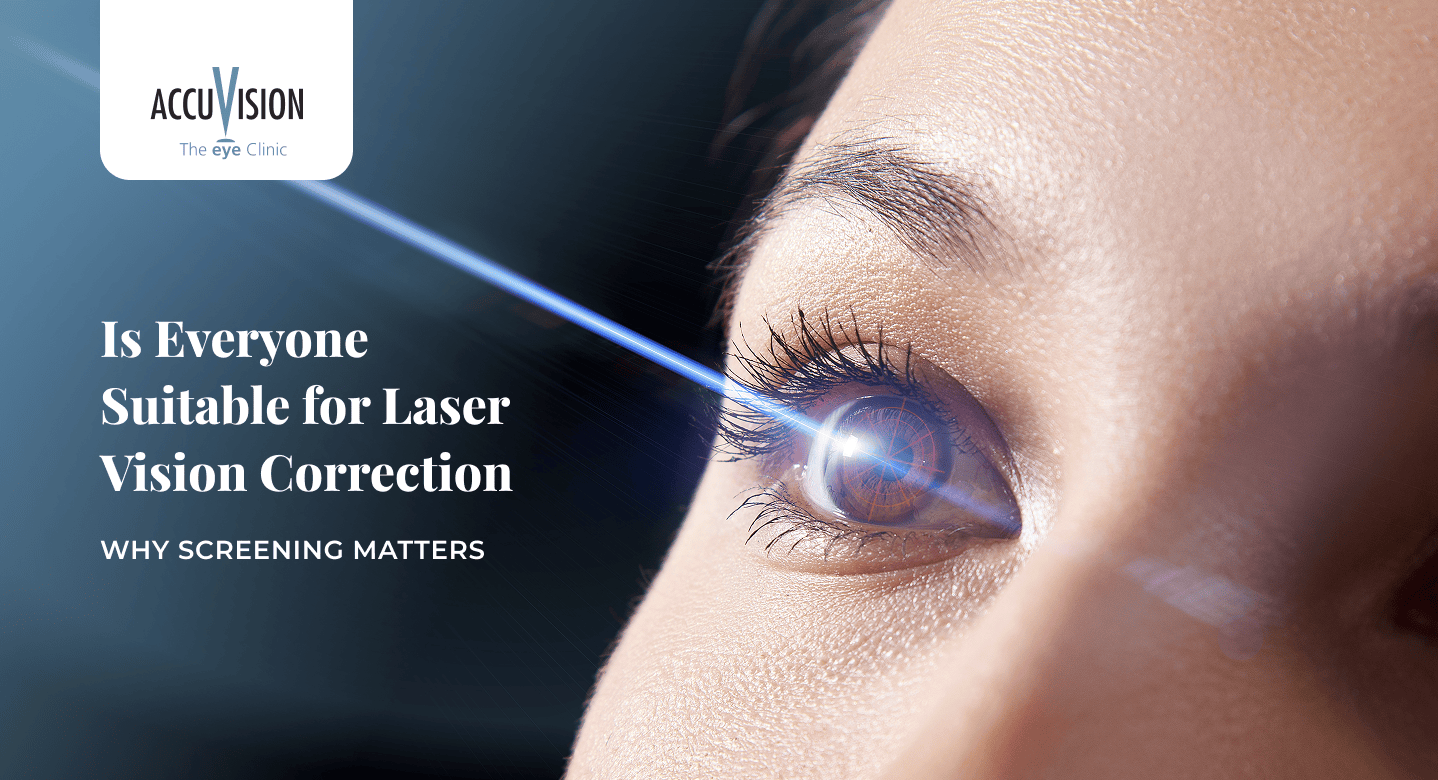
Laser surgery for correcting vision uses precise laser technology to change the shape of the cornea. Surgery alters the shape of the cornea by removing microscopic layers of tissue. This makes sure that light focuses correctly on the retina, resulting in clearer vision without glasses
There are several modern approaches like LASIK, Trans-PRK, LASEK and lenticule surgery, each suited to different corneal and overall patient profiles. The actual surgery usually only takes a few minutes, but determining whether someone is suitable or not can take over an hour and involves sophisticated diagnosis, sometimes with return visits in the pre-operative stage to initiate treatment or care measures that best prepare the eyes for surgery
Laser eye surgery works exceptionally well for the right candidates. But it’s not appropriate for everyone. There are several factors to be considered that influence suitability:
The procedure requires enough corneal tissue to safely reshape without weakening the eye’s structure. People with naturally thin corneas may not have sufficient tissue to remove during surgery, depending on the amount of correction required. Some technology platforms sacrifice less corneal tissue per dioptre of treatment, and some procedure techniques such as surface treatment, or combined therapy with cross-linking can offer tissue sparing and strengthening options.
Certain conditions pose additional challenges, such as irregular corneal profiles or keratoconus, which can cause progressive thinning and bulging of the cornea. This usually means that conventional laser treatment may not be the appropriate option or that other methods or treatments for these are needed. It is critical for the safety of patients to find these problems during professional screening.
Frequent and large changes in eye and general health concerns can be an exclusion factor, as it is best not to shoot at a moving target. If at assessment there is any indication that the eye profile is not stable, or systemic conditions are affecting vision, patients may be asked to take appropriate measures and return for monitoring until surgery can safely be offered.
Patients are required to be at least 18 years old to be eligible for corrective procedures. This, along with a stable eye and health profile, goes into the consideration factors for suitability.
Older patients face different considerations. Changes that occur with age, such as development of cataracts in the eye, might make other procedures more practical than laser correction.
An individual’s overall medical history plays a significant role while deciding whether laser surgery is ideal for them. Uncontrolled diabetes can impair healing. Dry eye or other conditions may need to be treated and intensively managed in the pre and post operative period to minimize the risk of any surgery. Autoimmune disorders can influence how the body responds to the procedure or heals, and so careful co-management with specialist doctors to cover prophylactic care and minimize risks is important.
Certain other conditions, especially if uncontrolled or progressive, eg glaucoma, cataracts, or problems with your retina may mean that corneal surgery is not appropriate. Sometimes these conditions need treatment before any corrective procedure can be considered, this is why it is important to consult with an expert team.
Pregnancy and breastfeeding cause hormonal fluctuations that can temporarily affect vision and corneal stability as well as healing response. Laser surgery is not recommended while pregnant or breastfeeding.
A thorough screening determines whether you are truly a suitable candidate and helps surgeons plan a procedure that’s both safe and effective.
Pre-surgical assessments aren’t routine eye tests; they involve advanced imaging and measurements. These tests show everything about the health and structure of the eyes.
Common screening tests may include:
All this information gives a full picture of the eye and visual system. Surgeons use this information to help you make informed decisions about the best treatment for you.
Advanced diagnostics can detect subtle changes in the cornea or eye health that regular eye assessments might miss. For example, subclinical keratoconus doesn’t show any clear signs or symptoms in its early stages, but advanced corneal imaging can detect it and enable early, proactive care to preserve vision.
Identifying issues early prevents complications that could arise later in life or after surgery. It also means patients can be monitored over time or directed towards more appropriate treatments before problems develop.
Every eye is different and needs its own care. Screening shows which procedure (LASIK, Trans-PRK, LASEK, or others) will work best for each person’s eyes and vision needs.
Screening can sometimes show that laser eye surgery isn’t the best treatment for that candidate. Implantable contact lenses or refractive lens exchange might deliver better results.
Laser technology is highly advanced today and surgical techniques have evolved significantly over the decades. But technology is only one part of the outcome. The real success of laser vision correction also depends on choosing the right candidates and planning the procedure with precision
Careful screening allows surgeons to understand every detail of the eye before making any decisions. This reduces the risk of complications, supports long term stability, and ensures that the treatment plan matches the patient’s needs. When a surgeon works with complete information about corneal health, prescription stability, tear quality, pupil size and overall eye condition, the final results are significantly more predictable.
Surgical success is built on accurate diagnostics, personalised planning and realistic expectations. These factors matter as much as the speed of the procedure or the type of laser used.
Knowing what to expect helps patients prepare properly:
Thorough preparation ensures the assessment can be as comprehensive and as accurate as possible
It can be disappointing to find out that laser eye surgery for vision correction is not for you. But a full and honest assessment protects eye health and prevents potential complications.
Being unsuitable doesn’t mean limited options. Implantable collamer lenses (ICL) work well for many people without altering the cornea. Refractive lens exchange (RLE) is a viable option for individuals developing early signs of cataract and indeed non surgical options such as specialist contact lenses or updated glasses can be the right thing for some.
Some patients need to get treatment for conditions like dry eye or inflammation before undergoing laser eye surgery.
When screening shows that a person is a suitable candidate for laser eye surgery to correct their vision, the surgeon talks to them about which procedure is best for their eyes and lifestyle.
Detailed instructions include what to do prior to surgery, what to expect on the day, how to take care of your eyes after surgery, and when to make follow-up appointments.
Most people can go back to their normal activities within a day or two of having laser eye surgery. Follow-up appointments keep track of progress to make sure that clarity and comfort improve and healing is as expected.
Surgeons also tell patients what to expect from the surgery, including short-term side effects like dry eyes or light sensitivity that usually go away during recovery.
Laser vision corrective eye surgery genuinely changes lives for many people. Freedom from dependence on glasses and contact lenses improves daily activities, sports participation, and overall quality of life. However, achieving quality outcomes begins well before the day of surgery. Patients do better when clinics put accuracy and clinical expertise ahead of speed.
When considering laser eye surgery for your vision, make sure to find specialists who take the time to do thorough evaluations. This dedication to thorough evaluation protects vision and increases the chances of getting excellent, long-lasting results.
This content was reviewed by the clinical team at AccuVision The Eye Clinic, a trusted UK-based centre for comprehensive laser vision correction and specialised eye care. With expert Ophthalmologists and Optometrists across the UK, AccuVision ensures that every article reflects accurate, medically reviewed information and supports evidence-based eye health awareness. This content is for general educational purposes only and should not be construed as medical advice. Always consult a qualified eye care professional for personalised guidance and treatment of specific conditions.
1. Who is an ideal candidate for laser eye surgery?
People with stable prescriptions, healthy corneas, and no active eye diseases are typically good candidates for laser surgery. A detailed screening with an eye specialist is the only way to determine suitability.
2. Is laser eye surgery to correct vision safer in London compared to other regions?
Laser eye surgery to correct vision in London follows strict clinical standards and regulations. Safety depends less on location and more on choosing a clinic with experienced surgeons, advanced diagnostics, and strong outcomes. Centres such as AccuVision follow rigorous screening and treatment protocols to ensure high standards of patient care.
3. How long does recovery take after laser eye surgery vision correction?
Most patients experience clearer vision within 24 to 48 hours. Mild dryness or light sensitivity can occur for a short period, but recovery is generally quick when postoperative instructions are followed.
4. Can someone with dry eyes still qualify for laser vision correction?
Possibly. Mild dry eye can often be treated before the procedure, while more severe cases may require alternative options like implantable lenses. Conditions differ from person to person, so it is important to get a proper eye screening from a qualified eye specialist to find out whether laser vision correction is suitable for you.
5. What tests are performed during a laser eye surgery screening?
Screenings usually include corneal mapping, retinal evaluation, tear film testing, prescription checks, and measurements of pupil size and corneal thickness. These tests allow surgeons to plan a personalised and safe treatment approach.