
7 Effective Ways to Relieve Itchy Eyes: Causes, Remedie...
7 Effective Ways to Relieve Itchy Eyes: Causes, Remedies, and Prevention Tips
...
August 18, 2026


Noticing small spots, threads, or shadow-like shapes drifting across your vision can be unsettling. These shapes often seem to move as your eyes move and may be more noticeable against bright or plain backgrounds, such as a clear sky, white walls, or digital screens.
These visual disturbances are usually known as eye floaters. They are very common and, in many cases, harmless. However, floaters can sometimes be linked to changes inside the eye that benefit from clinical evaluation. Understanding how floaters develop, what may cause them, and how eye care professionals assess them helps place these symptoms into the right context.
Please note that this content serves educational purposes only and does not replace professional medical advice. For persistent eye symptoms, we recommend booking a comprehensive eye examination at AccuVision.
Noticing New Floaters?
If you are seeing new spots, shadows, or flashes in your vision, a comprehensive eye examination including dilated retinal check is generally advised within 24-48 hours. You can arrange this with our expert team at AccuVision who can assess the vitreous and retina under controlled clinical conditions and complete specialised imaging of the retinal periphery.
Eye floaters are visual effects caused by small changes inside the eye rather than on its surface. They may appear as dots, strings, cobweb-like shapes, or faint shadows that drift across your field of vision.
Floaters originate from the vitreous humour, which is a clear, jelly-like substance filling the inside of the eye between the lens and the retina. The vitreous helps the eye maintain its shape and allows light to pass through to the retina. When small irregularities form within this gel, they can cast tiny shadows on the retina. The brain interprets these shadows as floaters.
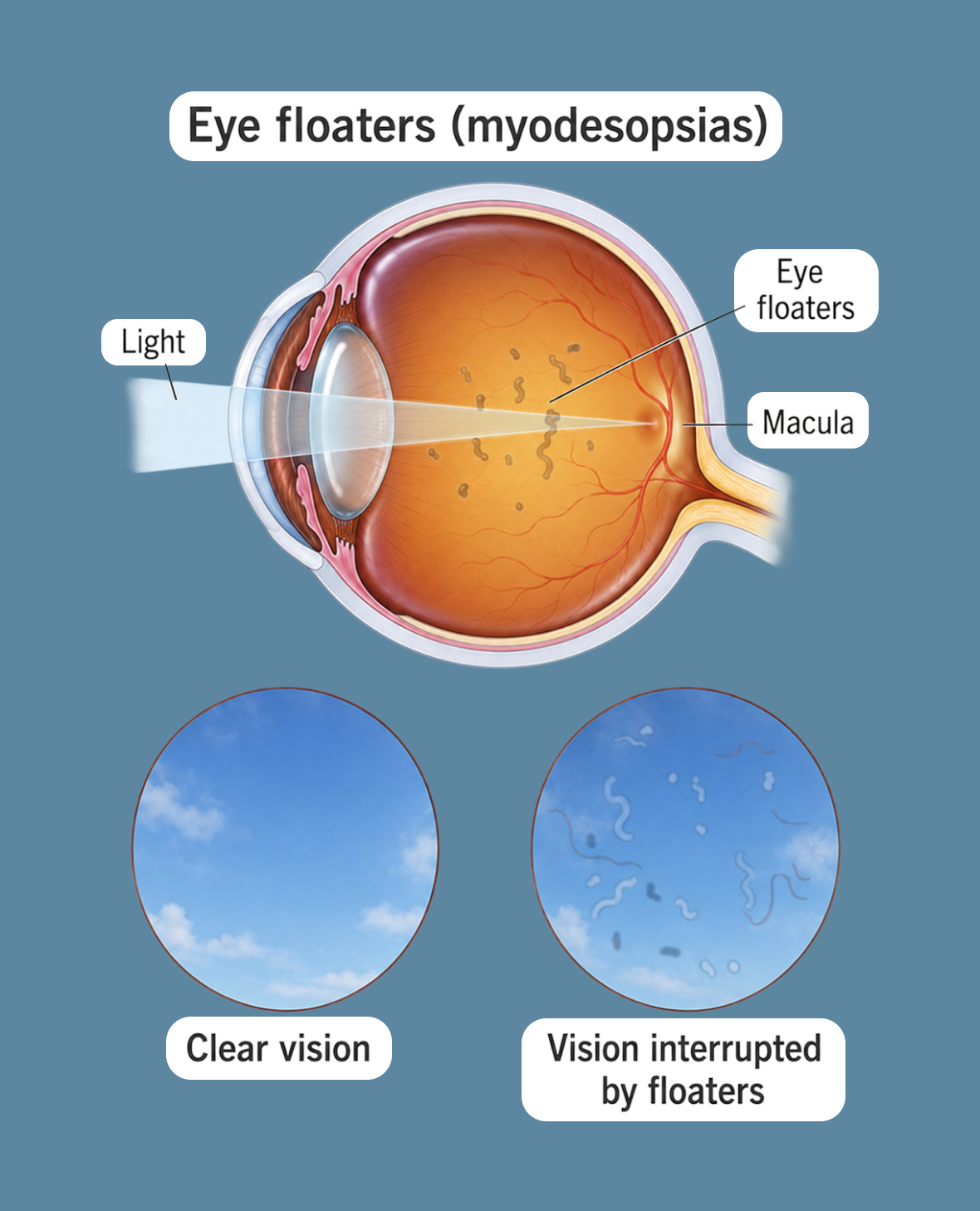
People describe eye floaters in different ways, but common descriptions include:
Floaters often appear to move away when you try to look directly at them. This happens because they are suspended within the vitreous gel, which shifts slightly as the eyes move.
In most people, floaters develop due to natural age-related changes inside the eye.
As we age, the vitreous humour gradually changes:
This process explains the majority of floaters in eyes seen during routine eye evaluations.
As the vitreous gel shrinks with age, it may pull away from the retina. This is called posterior vitreous detachment (PVD).
Key points about PVD:
Although PVD itself is usually harmless, a clinical eye evaluation is important. An eye examination helps confirm whether the vitreous is or has separated safely and ensures that the retina remains healthy, without breaks, tears or other complications such a detachment, which could impact vision.
While age-related vitreous changes are the most common cause, floaters can also be associated with other eye conditions.
In this context, floaters are assessed alongside:
This is why floaters are always evaluated within the broader context of eye and general health rather than viewed in isolation.
Certain factors increase the likelihood of developing or noticing eye floaters:
These risk factors do not mean that floaters are harmful by default. In most cases, floaters are benign and related to natural ageing. However, their presence provides important clinical context, as certain risk factors increase the probability of associated retinal conditions, making eye evaluation essential.
Many people notice that floaters appear more prominent on some days than others. This usually reflects changes in visibility, not changes within the eye itself.
Floaters are often more noticeable:
These fluctuations are common and can relate to perception rather than the progression of an eye condition.
When floaters are reported, eye care specialists focus on understanding their cause and clinical significance.
Evaluations commonly include:
This structured approach ensures floaters are assessed accurately rather than assumed to be harmless or concerning without evidence. Clinical guidelines also suggest that anyone presenting with new-onset floaters or flashes requires a dilated retinal exam.
How floaters are managed depends on what is found during an eye evaluation, including a detailed dilated retinal check. In many people, floaters are linked to normal changes inside the eye and do not require active treatment. In these cases, they are observed over time, and often patients learn to ignore them, or they can disappear or new ones appear from time to time.
If floaters are related to another eye condition, attention is directed towards identifying and managing that underlying issue. Any discussion about further steps follows detailed assessment and is based on individual findings.
Many people find that floaters become less noticeable over time as the brain gradually learns to ignore them. Awareness remains important, particularly if floaters change in number, size, or appearance.
Clinical evaluation helps ensure floaters are understood within the wider context of eye health.
Further eye evaluation is commonly considered when floaters:
Assessing these changes helps ensure eye health is maintained and potential concerns are identified early.
Eye floaters are a common visual experience that is most often linked to natural changes within the vitreous humour of the eye. Understanding how eye floaters develop, what causes them, how conditions such as diabetic retinopathy may be involved, and how specialists assess floaters in eye disease helps place these symptoms into perspective. While many floaters are harmless, clinical evaluation plays an important role when changes occur, supporting long-term eye health and reassurance.
Concerned About Vision Changes?
Sudden or increasing floaters should always be evaluated. Schedule a detailed eye examination at AccuVision for accurate assessment and personalised guidance.
This content was reviewed by Kareena Panthakey, BSc (Hons) MCOptom, part of the clinical team at AccuVision The Eye Clinic, a trusted UK-based clinic for comprehensive laser vision correction and specialised eye care for over 25 years. With expert Ophthalmologists and Optometrists across the UK, AccuVision ensures that every article reflects evidence-based eye health awareness. This content is for general educational purposes only and should not be construed as medical advice. Always consult a qualified eye care professional for personalised guidance and treatment for specific conditions.
1. What causes eye floaters?
Eye floaters are most commonly caused by natural changes in the jelly-like substance inside the eye, particularly with age.
2. Are eye floaters always a sign of eye disease?
No. Most floaters are harmless and related to normal eye changes. Some may be linked to eye conditions, or signal risk of retinal changes, which is why assessment is important.
3. Why do floaters move when I move my eyes?
Floaters move because they are suspended within the vitreous gel, which can shift slightly as the eyes move.
4. Can diabetes cause eye floaters?
Yes. Diabetic retinopathy can cause floaters when damaged retinal blood vessels leak or bleed into the vitreous.
5. When should floaters be assessed by an eye care professional?
Floaters are commonly assessed when they appear suddenly, increase rapidly, or occur with other visual changes.