
Seeing Spots or Shadows in Your Vision? Understanding E...
Seeing Spots or Shadows in Your Vision? Understanding Eye Floaters and How They Develop
...
August 18, 2026

Recognising colours accurately is something most people rarely think about. From traffic lights and safety signs to schoolwork, charts, and certain careers, colour vision plays a quiet but important role in daily life. When colours appear confusing or difficult to tell apart, it can raise concerns about whether colour vision is working as it should.
A colour blindness or colour deficiency test is designed to assess how well the eyes and brain work together to perceive colour. These tests are used for both adults and children, including young learners who may benefit from a colour vision screening test as preschoolers.
This blog explains what colour vision tests are, the types used by eye care professionals, how they work, and what the results can tell you about your vision.
Please note that this content serves educational purposes only and does not replace professional medical advice. For persistent eye symptoms or vision concerns, we recommend booking a comprehensive eye examination at AccuVision.
Concerned About Colour Vision?
If you or your child have difficulty distinguishing colours, a Consultant-led comprehensive eye examination at AccuVision can provide accurate clinical testing and clear guidance.
A colour vision or colour blindness test is a clinical assessment used to evaluate colour perception. It does not measure how sharp your eyesight is. Instead, it focuses on how accurately you can distinguish between different colours and shades.
Eye care professionals may recommend colour vision testing:
Online colour tests can be helpful for awareness, but they are not diagnostic and should be used with some caution. Accurate testing requires specific standardised lighting conditions and professional testing tools and charts.
Colour vision tests help determine whether colour vision falls within the expected range or if a colour vision deficiency is present. Colour vision deficiencies can be varied in type and grade.
This information can be important for:
Most inherited colour vision deficiencies are present from birth. However, colour vision changes that develop later in life should always be assessed professionally as they may signal other eye or general health concerns.
Eye care professionals rely on well-established, evidence-based colour blindness tests that are supported by clinical research and used by major medical institutions.
The Ishihara test is the most widely used colour vision test and is sometimes referred to as the red and green colour-blind test.
How do Ishihara colour vision tests work?
You are shown a series of circular plates made up of coloured dots that form numbers or shapes. People with normal colour vision can usually identify the figures easily, while those with red-green colour blindness may see a different figure, number or none at all.
What do Ishihara colour vision tests assess?
Ishihara colour vision tests assess red-green colour vision deficiency.
This test is commonly used as an initial screening tool for adults and older children.
Pseudoisochromatic plate tests are a group of colour vision tests that include Ishihara-style plates and similar screening tools used in clinical practice.
How do pseudoisochromatic plate tests work?
You are shown images made up of coloured dots that form numbers, shapes, or symbols. Certain colour combinations are designed to appear similar to individuals with colour vision deficiency, making the figures difficult or impossible to recognise.
What do pseudoisochromatic plate tests assess?
Pseudoisochromatic plate tests assess colour vision deficiencies, with a particular focus on red-green colour vision deficiencies.
These tests are widely used as initial screening tools because they are quick, non-invasive, and suitable for testing both adults and children, including large groups.
The Farnsworth D-15 is a colour arrangement test.
How does the Farnsworth D-15 test work?
You are asked to arrange coloured discs in an order that follows a gradual colour sequence.
What does the Farnsworth D-15 test assess?
This test is often used after initial screening to provide additional detail.
The Farnsworth-Munsell 100-Hue test is a more detailed colour discrimination assessment.
How does the Farnsworth-Munsell 100-Hue test work?
You arrange a larger number of coloured caps into a smooth colour gradient.
What does the Farnsworth-Munsell 100-Hue test assess?
Because it takes longer to complete, it is usually reserved for situations where detailed analysis is required.
An anomaloscope is a specialised instrument mainly used in research or specialist clinical settings.
How does the anomaloscope test work?
You adjust colour mixtures to match a reference colour under controlled conditions.
What does the anomaloscope test assess?
This test is considered highly accurate but is not typically used in routine eye examinations.
The City University Colour Vision Test is a plate-based screening tool that helps identify and classify different types of colour vision deficiency, including defects that other common tests can miss.
How does the City University test work?
You’re shown a series of plates, each with a central reference colour surrounded by four peripheral colour options. On each plate, you pick the peripheral colour that most closely matches the central one.
What does the City University test assess?
This test is valued for being quick and easy to administer, though it may have drawbacks when it comes to precision.
Testing colour vision in young children requires age-appropriate methods. A colour vision test for preschoolers avoids letters and numbers and instead uses:
Early identification helps parents and teachers adapt learning materials and reduce confusion during early education.
Most colour vision tests are quick and painless. They are usually performed in standard vision testing room conditions with correct lighting.
You may be asked to:
Results are often available immediately. In some cases, more than one test is needed to fully understand colour vision patterns and referral may be needed for more specialised tests.
Results from a colour vision assessment test may indicate:
| Result | What It Means |
|---|---|
| Normal colour vision | Colours are seen within the expected range |
| Red-green colour deficiency | Difficulty distinguishing red and green shades |
| Blue-yellow colour deficiency | Difficulty distinguishing blue and yellow tones |
| Significant other colour vision deficiency | Rare and may require further evaluation |
Inherited colour blindness typically remains stable over time. If colour vision changes develop later in life, professional assessment is important as there is usually an underlying eye or health condition.
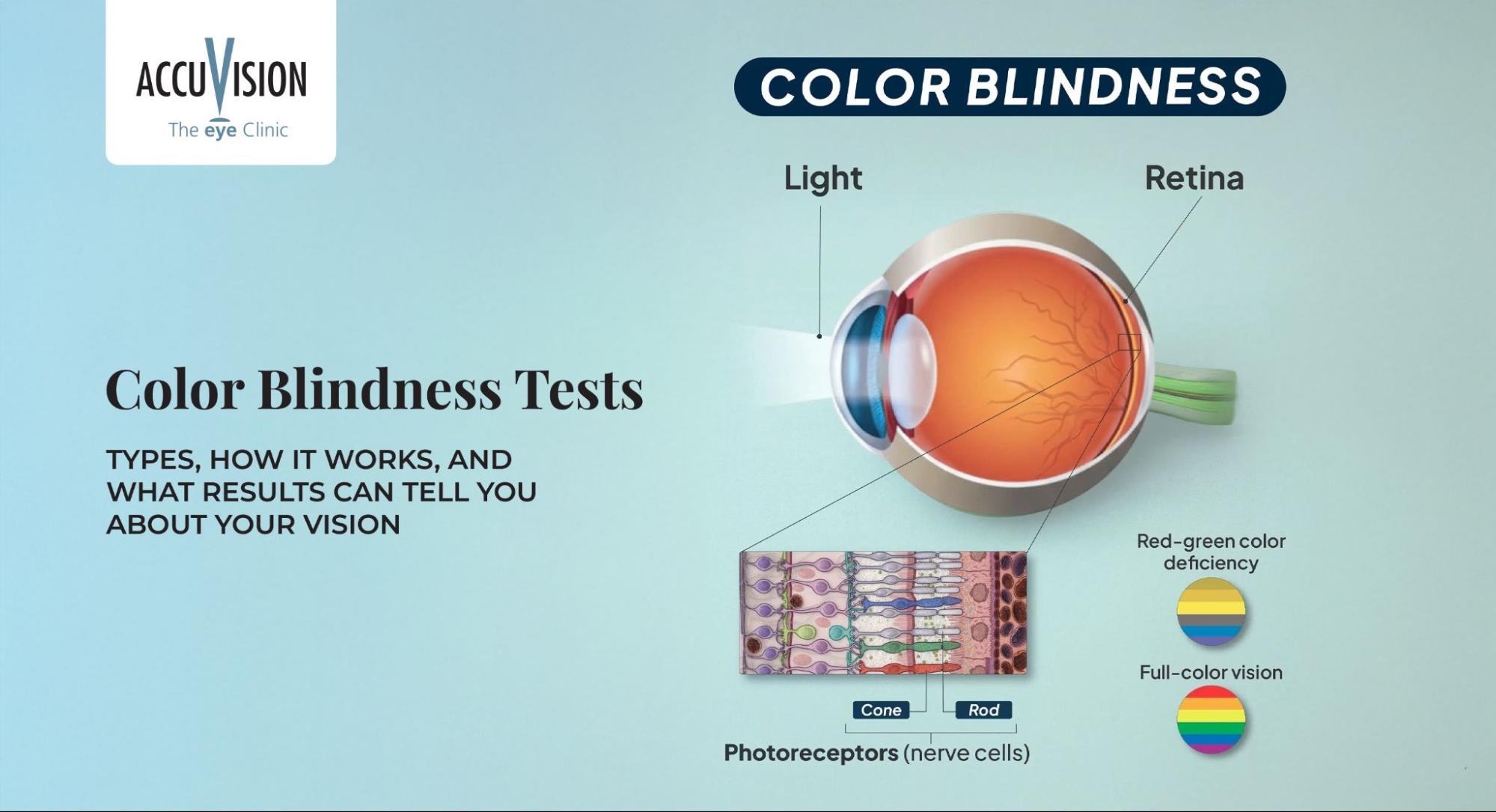
Colour blindness occurs when cone cells in the retina do not respond normally to certain wavelengths of light.
Possible causes include:
A colour vision test identifies patterns of colour vision deficiency but does not determine the cause alone without further evaluation and investigation.
Eye care professionals may recommend colour vision testing if:
Colour vision tests are important tools for understanding how the eyes perceive colour. From common screening methods to more detailed assessments and age-appropriate options like a colour test for preschoolers, these tests help identify colour vision differences accurately. Understanding the types of colour defect tests, how they work, what results may indicate, and when professional evaluation is needed supports informed decisions about learning, daily activities, and eye health and sometimes career choices.
If you or your child have concerns about colour vision, a comprehensive eye assessment is the most reliable way to gain clarity. At AccuVision, colour vision testing is part of a detailed eye evaluation led by experienced specialists, helping ensure results are interpreted correctly and appropriate guidance is provided.
Need Clarity on Your Colour Vision?
Book a comprehensive eye assessment at AccuVision for structured colour vision testing and personalised advice from experienced specialists.
This content was reviewed by Kareena Panthakey, BSc (Hons) MCOptom, part of the clinical team at AccuVision The Eye Clinic, a trusted UK-based clinic for comprehensive laser vision correction and specialised eye care for over 25 years. With expert Ophthalmologists and Optometrists across the UK, AccuVision ensures that every article reflects evidence-based eye health awareness. This content is for general educational purposes only and should not be construed as medical advice. Always consult a qualified eye care professional for personalised guidance and treatment for specific conditions.
Q1. What are the different types of colour vision tests?
Common colour blindness tests include Ishihara and other pseudoisochromatic plate tests for red-green colour blindness, arrangement tests such as Farnsworth D-15 and Farnsworth-Munsell 100-Hue, and specialist tests like the anomaloscope for detailed assessment.
Q2. What do the results of a colour vision test show?
Results indicate whether colour vision is normal or if a colour vision deficiency is present, most commonly red-green or, less often, blue-yellow colour blindness.
Q3. What are the main types of colour blindness?
The main types are red-green colour blindness, blue-yellow colour blindness, and complete colour vision deficiency, which is rare.
Q4. What do people with complete colour blindness see?
People with complete colour blindness, known as monochromacy, see only shades of grey rather than colour.
Q5. Can preschool children have a colour vision test?
Yes. A colour vision test for preschoolers uses shapes or symbols instead of numbers to assess colour vision accurately. If there are concerns about a child’s colour perception, a comprehensive eye assessment at AccuVision can help ensure accurate evaluation and appropriate guidance.